This 2016 International Democratic Education Conference was held in Mikkeli, Finland. It was co-sponsored by the EUDEC, the European Democratic Education Community, which is one of the sub-groups that grew out of the IDEC. The first IDEC was a small meeting of democratic educators that was organized by Yaacov Hecht in 1993 at the Democratic School of Hadera, in Israel. The IDEC is not an organization, by design. At each conference we find schools and organizations to organize future IDECs.
There was a weekend of EUDEC meetings before the IDEC officially started on Monday, June 6th. The key organizer of this IDEC was Marko Koskinen, who worked with several local partners.
One of the most striking discoveries that the participants first realized is that it is still light in Finland well past 10 PM at this time of year and that the sun comes up at 4 AM! This makes sleeping problematic for some. Also, the days were packed full of activities. Sometimes going past 11 PM.
Unlike many education conferences, more than half the participants are students, many from democratic schools. People came from 35 countries!
We learned several startling things about Finnish public schools:
Parents can not be charged for education because of the need for equality. If you start an independent school the government pays for most of it. Homework is restricted to a half hour time and it is illegal to give homework for weekends or vacations. There is practically no testing of younger students and very little thereafter. Teaching is an esteemed profession. As everyone knows, Finland scores the highest on international measurement tests, so why do we ignore what they do?
One significant thing we learned from this conference is that democratic and learner-centered schools and programs are expanding rapidly in many countries. For example, the first democratic, learner-centered school in Poland was started by a woman who took AERO’s school starter online course. She also subsequently attended an AERO conference. Not only is that school flourishing, but it has led to several others being started around Warsaw, and about 30 around Poland! We found there are two new democratic schools that have started in Paris and more that are starting around the France. Much is also happening in Spain, with a new democratic school in Barcelona represented at this IDEC. There was an attendee from Egypt, which underscores the fact that there were several students in this year’s school starter course from Arab countries. A large group attended from Korea, which hosted the IDEC two years ago. When there was an attempt there to rein in the many new democratic schools that had started there, we organized a protest in Seoul. It was apparently successful as they backed off this attempt. There was another large delegation from an alternative school in Taiwan, as well as a representative from mainland China. Israel already has over 25 public democratic schools and there are at least six more starting. In Germany, there are now more than 100 democratic schools and in general, there are no openings and a waiting list. When we had the IDEC in 2005 in Germany democratic schools were illegal and people were being arrested for it. Our presentations at an important university partially led to this change. After a huge increase and a steep drop when Netherlands instituted a national curriculum, democratic schools are again on the rise there. Keynote speaker Brother John Kennedy Omondi Oronjo from Kenya has started a learner-centered boarding school for orphans and dropouts for 300 students. They plan to host the 2019 IDEC in Kenya.
Of course, there are still many schools in some countries that are struggling with rigid school bureaucracies. For example, new schools in Hungary and the Czech Republic have great difficulties. Home education is still illegal in many countries, such as Germany, Netherlands, and Sweden.
For the first three days, spontaneous workshops were posted and presented. In one interesting presentation, an educator from Netherlands who has experienced many difficulties with school inspectors and bureaucrats there talked about how he has developed a strategy to work with the school inspectors. It included learning how to speak the inspectors’ language and finding out what they needed. One interesting piece of information was that the closing of democratic schools may have been collateral damage in the closing of radical Islamic schools.
After several new schools mentioned to me that one of their great needs was the creation of an international accrediting agency to aid with their problems with the education bureaucracy, I organized a workshop on the subject. One of the attendees, Derry Hannam, was a former English school inspector who has helped many schools with such problems. Many people, particularly AERO school starters have been asking AERO to do this for a long time. We will investigate possibilities.
I went to a workshop by Vlad and Natalia, Summerhill parents. They have started a website and an organization to provide support for parents looking for educational options, particularly democratic schools. One thought we had was to have success stories and examples on the site. Another was to have a limited livestream of democratic schools so parents could have more direct experience with this.
I went to a workshop with EUDEC staff member Chloe Duff about the establishment of a continuing IDEC website instead of a new one each year by each organizing group. We ended up buying a domain and getting the ball rolling.
We had a meeting with the organizers of next year’s IDEC, to be held in Israel in March 2017. There were ten organizers of previous IDECs there to help them. It was an amazing meeting covering such things as financing, location, scholarhips, and fundraising, among other things.
During the first three evenings, we had IDEC meetings. One issue was the question of whether the Sri Aurobindo Ashram/orphanage in Nepal would still be able to host the 2018 IDEC after the extensive earthquake damage they sustained. Unfortunately, Finland refused to give the Nepalese visas so they could attend the IDEC even though funding had been found for them. I was able to Skype them and Ramchandra told me that because of the extensive damage they had decided they could not be ready. They had actually started construction on a big hall when the earthquake struck and it did so much damage to their existing buildings that construction was put on hold. They do much of the work themselves. So they asked that their hosting be postponed until 2020. At the IDEC meetings, there were some suggestions for 2018 but nothing was decided.
For one of my workshops, I showed a video montage of the first six IDECs. I went to another one about research that has been done on democratic and learner-centered education. There hasn’t been much since the 8 Year Study of progressive education in the 1930’s, but there is a great need for it. What little that has been done clearly shows that students do better by almost every measure with a learner-centered approach.
The last two days consisted mostly of keynotes at the beautiful Mikaeli Congress House. These were given by leaders of the movement such as Yaacov Hecht of Israel (Changing the Paradigm from a Pyramid to a Network), Sugata Mitra (The Future of Education), Justo Mendez and Ana Yris of Puerto Rico ( Democratizing Education—A Mission of Love), Henry Readhead of Summerhill, Chloe Duff of EUDEC, Tae Wook Ha from Korea, Derry Hannam and several leaders from Finland. My keynote was a (rare for me) Powerpoint on the History of Alternative Education. These should be available on the Internet at some point.
On the next to last evening, someone came to me to ask me to do an auction to help erase and conference deficit and if costs were covered it would be seed money for the next IDEC. It was a daunting task on two hours notice, but it was a lot of fun and an enthusiastic crowd raised more than 500 Euros.
Overall it was a really wonderful and productive gathering. Now I need to get back home to get ready of the AERO conference in Portland, August 3-7. The AERO conference grew directly out of the IDEC that we co-sponsored in 2003 with Albany Free School. We had the first one the next year, in 2004, so this will be our 13th. I’ve been to 20 IDECs.
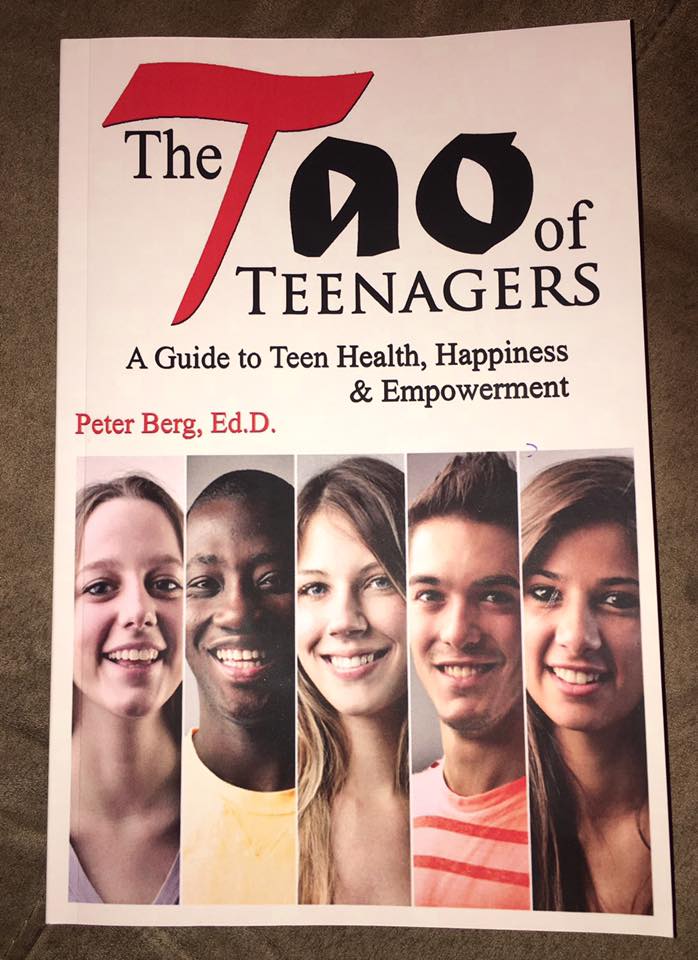 In The Tao of Teenagers: A Guide to Teen Health, Happiness & Empowerment, Dr. Peter Berg takes readers on a journey through his experiences working with teens over the last 25 years. He shares his approach to teen health, happiness and empowerment through his eyes and the eyes of teenagers. This book is as a much an invitation to dialogue as it is a guide.