Posted on

Peter Berg will sell his new book first at the AERO Conference!

Peter Berg will sell his new book first at the AERO Conference. It will be for sale here weeks before you can buy it on Amazon or anywhere else.


Book Description:  
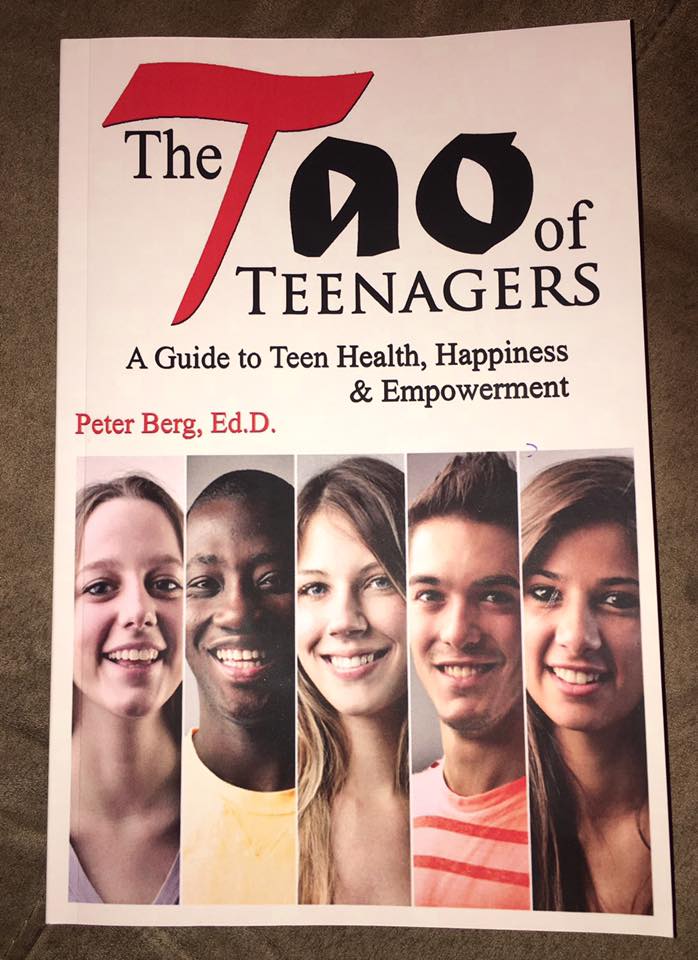
In The Tao of Teenagers:  A Guide to Teen Health, Happiness & Empowerment, Dr. Peter Berg takes readers on a journey through his experiences working with teens over the last 25 years.  He shares his approach to teen health, happiness and empowerment through his eyes and the eyes of teenagers.  This book is as a much an invitation to dialogue as it is a guide.  

Berg details the experience of teens he has worked with, he invites adults and teens alike to practice different approaches to teen health and happiness as they empower themselves to make the best decisions for their lives.  An essential book for any adult who lives, learns or works with teens and essential for any teen interested in their health, happiness and empowerment. 

Bio:

Dr. Peter Berg, the founder of Youth Transformations, works with youth as a board Certified Holistic Health and Mental Health Coach and is currently the Principal of The New School, a Democratic School, in Maine. 

His work includes helping teenagers empower themselves so they can take charge of their health and happiness and be the masters of their own lives.  

He holds a Doctorate in Educational Leadership and has written extensively on alternative, holistic, integrated educational theory and integrated health.  He also serves as a faculty member for the Self-Design Graduate Institute.  

Peter organizes the Alternative Education Resource Organization representatives worldwide and is a reviewer for the American Educational Research Association.  He has consulted on many school and organizational startups.  

To learn more about Peter's work, please visit www.youthtransformations.com.

Posted on

Excerpt from Jerry Mintz’s “A History Of Alternative Education” Presentation.

The alternative education movement goes back well before there was a name for it. In fact it could be argued that what we now call alternative education and homeschooling was the norm for humankind for millennia.
 
The difference in paradigm between what we now call alternative education and the current mainstream education is very dramatic. In 95% of schools around the world it seem that a basic belief is that children are naturally lazy and need to be forced to learn. We’ll come back to that later.
 
The paradigm for alternative, learner-centered education is that children are natural learners and do not need to be forced to learn.
In fact modern brain research has shown that the more you force children to learn things that do not interest them, the more you extinguish the natural interest and ability to learn.
 
If you accept the first paradigm that children must be forced to learn you need a whole series of external devices to force it. This would include competition for grades, homework assignments, suppression of spontaneous learning, suppression of verbal interaction. In other words, you would have a typical classroom.
 
If you believe in the second paradigm that children are natural learners your main job would be to help find resources for the students, coach them in the direction they choose to go. You would have to develop the ability to listen well to them to help determine these things. There are definitely differences in the ways alternative educators do this, which we’ll talk about later, but the commonality is that it is a learner-centered approach.
 
As I said, the alternative education movement goes back far into the past. It could be argued that the current public school system is just a relatively short experiment, spanning only 150 years or so.
 
The ideas behind a learner-centered approach keep on popping up throughout history, perhaps because they work. One early proponent was Jean Jaques Rousseau, whose Emile also known as On Education, was based on these ideas. Emile was banned in Paris and Geneva and was publicly burned in 1762, the year of its first publication. Ironically, during the French Revolution, Emile served as the inspiration for what became a new national system of education.
 
We move forward to Bronson Alcott. Born in 1799 and largely self-educated, he founded a series of controversial schools in the 1830’s in the Philadelphia and Boston area. He was influenced by the European reformers such as the Swiss Johann Heinrich Pestalozzi and Friedrich Frobel.
 
In 1830, with William Lloyd Garrison he founded an anti-slavery society.
 
One of his schools, the Temple School (because it operated out of a Masonic Temple) was a forerunner of progressive and democratic schooling. It caused a lot of controversy because he accepted an African American girl and refused to expel her. Many parents withdrew their students and soon he was left with just a handful, including his own daughter Louisa May Alcott. As you know, she went on to write books such as Little Men and Little Women, largely based on her experiences in her father’s alternative school.
 
By the way, some of the connections back then were amazing. Emerson was a financial supporter of Alcott and in 1845 Bronson Alcott lent his Axe to Henry David Thoreau so he could build his home at Walden Pond.
 
Many of Alcott's educational principles are still used in classrooms today, including "teach by encouragement", art education, music education, acting exercises, learning through experience, risk-taking in the classroom, tolerance in schools, physical education/recess, and early childhood education


Posted on

SailFuture is seeking an entrepreneurial and passionate teacher

SailFuture

Service Learning Teacher

SailFuture is seeking an entrepreneurial and passionate teacher with experience with service-learning projects to help build a paradigm-shifting high school service learning program that seeks to reinvent how we engage foster youth with criminal charges (16-18 years old). The innovative group home model takes place partly on a 65-foot sailboat named “Defy the Odds” and aims to demonstrate what happens when you empower youth with real life skills, rich experiences, and leadership/ service opportunities. SailFuture is a child welfare and juvenile justice agency based in St. Petersburg, FL that works with 16-17 year old boys in foster care who are dually served by the Department of Juvenile Justice. We are not a typical child welfare or juvenile justice agency and this position is not for an educator seeking an opportunity to teach in a traditional classroom setting. We believe that it is a privilege, not a given, to be able to help break the cycle of incarceration and generational poverty in a young man's life. As the teacher, you work side by side with a mental health counselor and captain to teach and develop six youth every day for 12-months.  The teacher will have full control over their high school curriculum and the structure and specific service projects built into the service learning program. The service learning program will be fully accredited by Hillsborough County school board.


For the first 3-months of the program, the teacher will live with six students on a 65-foot sailboat and navigate more than 700 nautical miles around the coast of Florida. This unique approach is our key to building the trust and understanding necessary to truly change the trajectory of another human being's life.

Following the sailing journey, the teacher will stick with their six youth as a house parent for 8-months, living with the young men in a waterfront home in St. Pete. Leveraging the relationships built at sea, the teacher will help each young man continue to grow personally, professionally, and ensure the attainment of their GED or high school diploma. The teacher will serve as a house parent with a mental health counselor and two house coordinators.

This is a two-year position that requires a full-life commitment to the well-being and success of the kids we serve. The return is a unique opportunity to make a defined, transformational impact in the lives of some of society's most challenging youth. 

Responsibilities:

  • Living on a 65'; sailboat and a 4 bedroom home and assisting with daily living operations
  • Responsible for the educational success of all 9 youth
  • Teach service learning classes tied to each service project
  • Prepare individual education assessments for each youth
  • Develop an academic plan for high school graduation and post-secondary education opportunities based on each youth's education assessment Maintain weekly reports on each youth's academic progress
  • Assist with enrollment for all youth re-entering traditional high school
  • Nightly tutoring sessions
  • Assist with job and education placement
  • Drive youth to and from school, work, doctors appointments, and other activities   

Minimum Qualifications:

  • A passion for water, boating, swimming, or sailing
  • Bachelors + 2 years teaching experience
  • Valid driver's license
  • First Aid / CPR (provided by SailFuture)
  • De-escalation tactics (provided by SailFuture)
  • Trauma Informed Care (provided by SailFuture)
  • Offshore sailing competency course (provided by SailFuture) 

Compensation &Benefits

  • Total compensation: $45,000 base salary; Housing, food and health insurance included in compensation plan (value – $20,000)  
  • Salary: $25,000
  • Food: $8,000
  • Housing: $9,500
  • $2,500 signing bonus at start of 2nd year
  • 4 weeks paid vacation

To apply, please send your resume and cover letter to executive director Michael Long at

mlong@sailfuture.org


Contact: 

Michael Long

MLong@sailfuture.org

(941) 219-9847

Posted on

Description Of The Nepal Earthquake By 7th And 8th Graders

My name is Sarmila. I am a 15 year old girl. On the day of the earthquake I was loading fertilizer on the truck. Other people were working in the field. Others were getting cow food. Everybody was outside when the earthquake hit. If everyone was inside some people would have been killed. Many of our buildings fell down. Many walls fell down. We have eight buildings here. In the school building many walls fell down, windows broke,  etc. We were very afraid. It was a 7.5 quake. I could feel the earth moving. I had never been in an earthquake before.
 
I looked everywhere in the community to see what the damage was. I felt sad. A lot of the children were  crying. Sounds were coming from everywhere.  The air was very thick with dust. The sky was dark with a black cloud. The teachers went into all the buildings to see if everyone was OK. Everybody here was OK. The army went around Nepal to help people who were  hurt, take away the dead, bring people to the hospital.
 
There was no electricity for four or five days. The water was not running. We had to bring water in.
 
Everybody stayed here. We stayed all around the community. We couldn’t live in the dorm anymore because it was dangerous. The building could fall down. For a while we stayed in the reception building, in tents, and any place we could find.
 
Now it getting better. Some people still sleep in the school. A lot of the buildings are not repaired yet. The water is working again.
 
Everybody has been active  and strong. We hope there won’t be another earthquake.